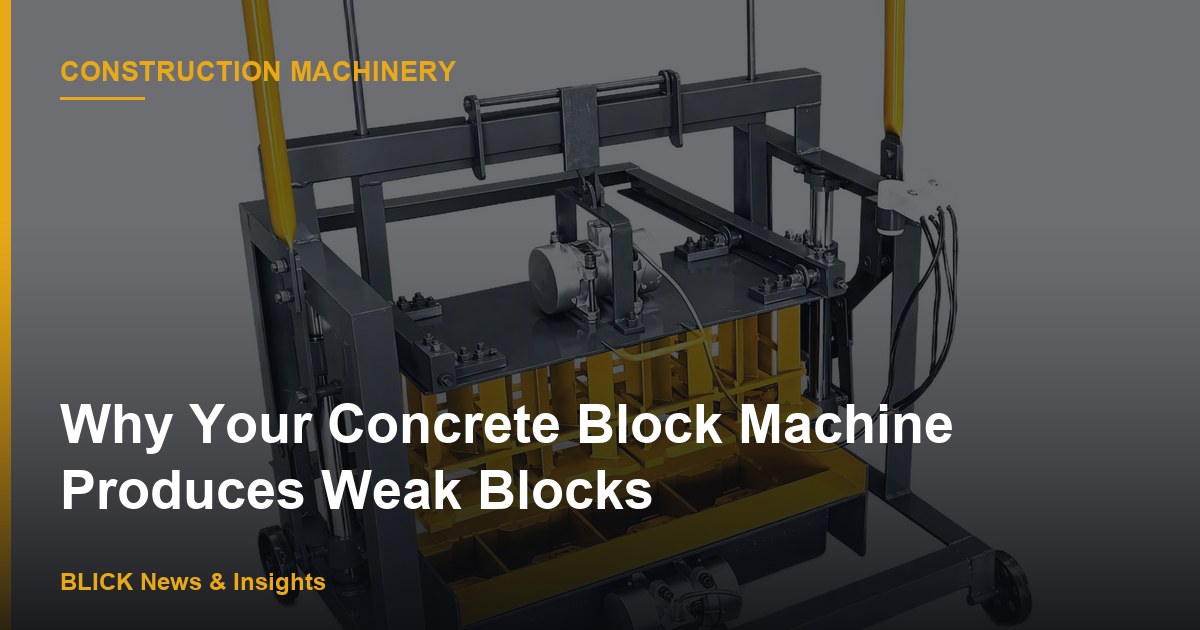
Weak blocks are the most common complaint we hear from block producers, and the most expensive, because by the time the problem is visible in the yard you have already paid for cement, aggregate, labour, curing and yard space on a batch that cannot be sold.
The good news is that weak blocks almost always come from one of six causes, and each one has a specific, testable fix. Here is how to work through them in order, from the most likely to the least.
1. Water content of the raw materials is not controlled
This is the number one cause, and it is the one producers most often overlook because it is invisible in the finished block.
Sand and crushed stone arrive with varying moisture. When the moisture in the aggregate goes up, the exact same mix recipe produces a wetter, softer mix. More water means the blocks have higher porosity after curing, and porosity is the enemy of compressive strength.
Symptom: The same recipe produces good blocks one day and weak blocks two days later, with no change in machine settings.
Fix: Measure aggregate moisture at least twice per shift and adjust the water addition accordingly. If you are still measuring by feel, that is the problem. A moisture meter pays for itself within a month.
2. Cement content is being judged by volume, not by weight
Batching cement by volume — by counting sacks or by bucket — introduces large errors. Cement that has been stored in humid conditions compacts and settles, so the same volume contains more cement than fresh material, or less if it has partially set.
Symptom: Block strength varies between batches made from different deliveries of the same nominal cement quantity.
Fix: Batch cement by weight. On a concrete batching plant this is automatic; on a manual or semi-automatic line it means using a proper weighing scale rather than a volumetric measure. Accuracy of ±1% is achievable and is what the mix design assumes.
3. Aggregate grading is wrong
Strength comes from a dense, well-graded aggregate skeleton. Two opposite failures cause weak blocks:
- Too much fine material — excessive dust or clay in the sand increases surface area and therefore the water demand, so cement is effectively diluted.
- Gaps in the grading curve — if you are using a single coarse aggregate with no intermediate sizes, the voids between large particles never get filled. The block has internal empty space by design.
Symptom: Blocks feel heavy but break with a rough, granular fracture and visible voids.
Fix: Run a sieve analysis on your sand and stone. Then either blend two or three aggregate fractions to close the grading curve, or change your sand source. Also wash or screen out excess clay — clay does not just dilute the mix, it physically interferes with the cement hydration bond.
4. Insufficient compaction in the mould
A block machine does not cast blocks; it compacts a very dry mix under vibration and pressure. If the compaction energy is too low, the block contains air that should not be there.
Typical causes:
- Vibration time set too short to increase output
- Mould fill weight reduced to save material
- Worn vibration motor mounts, so the vibration is no longer transferred efficiently into the mould
- Worn or misaligned mould liners, creating an uneven fill
Symptom: Block density varies from one end of the pallet to the other, or the top corners crumble.
Fix: Restore the original vibration time and fill weight for a trial batch, then compare density and 7-day strength. If the machine cannot hold density even at the correct settings, service the vibration system and check the mould wear. Worn moulds are the single most common machine-side cause of strength loss on an older line — see the machine options on our brick making line page.
5. Curing is too short, too dry, or too cold
Curing is where concrete develops its strength, and it is where producers cut corners because it costs time and yard space. Cement does not dry — it reacts with water. If the block loses its moisture too early, the reaction stops and the block never reaches its design strength, no matter how good the mix was.
Symptom: Blocks test well at 3 days but plateau early, and never reach their target 28-day strength.
Fix: Keep blocks damp and shaded for the full curing period. Practical measures that matter:
- Cover the pallets with plastic sheeting or cure in a chamber rather than leaving them in direct sun and wind.
- Water the blocks on a schedule, or use a mist system. Do not soak them cold — avoid thermal shock.
- Extend curing time in cold weather, and never let blocks freeze while green.
- Do not move green blocks early to free up yard space. The first 24 hours matter more than any other period.
6. Machine wear and mixer inconsistency
If the mix design and curing are correct but strength still drifts, look at the mixing and forming equipment:
- Worn mixer blades and liners — mixing efficiency drops, and the same mixing time no longer produces the same homogeneity. Partially mixed dry mixes are the classic source of random weak blocks.
- Inconsistent discharge — mix that segregates as it leaves the mixer gives you blocks that differ from the first pallet to the last.
- Worn moulds and liners — dimensional wear reduces compaction and changes the density the block can reach.
Fix: Replace mixer wear parts on an interval based on tonnage produced, not on appearance. Log mixing time and verify it is actually being achieved on every batch — on automatic lines this is measurable; on manual lines it is often the silent variable.
How to diagnose this systematically instead of guessing
Do not change five things at once. Work in this order and measure after each step:
- Test the compressive strength of a current production batch at 7 and 28 days. You need a baseline figure, not an opinion. A lab press or even a certified third-party test saves money by ending the guesswork.
- Record aggregate moisture for three consecutive days alongside those strength results. This alone identifies cause 1 in most plants.
- Verify cement is being batched by weight, and check the calibration of the weighing system.
- Run a sieve analysis on the aggregates.
- Only then start touching machine settings, one at a time.
If you are choosing equipment for a new line, or replacing a machine that cannot hold density, compare the specifications and the vibration and compaction systems on our fully automatic brick making line and concrete batching plant pages. Compaction capacity and batching accuracy are the two specifications that most directly determine block strength.
A note on curing temperature
If you produce blocks in a hot, dry climate — common across the markets we supply — curing is where most strength is lost, and it is the cheapest thing to fix. A simple shade structure and a watering schedule routinely lift 28-day strength by a meaningful margin on the same mix design. Before you spend money on a new machine, spend a week proving that your current curing regime is actually being followed.
If you send us your mix design, aggregate grading and current 28-day test results, our engineers will tell you which of the six causes is most likely in your plant, and what to change first. Send us your production data here.